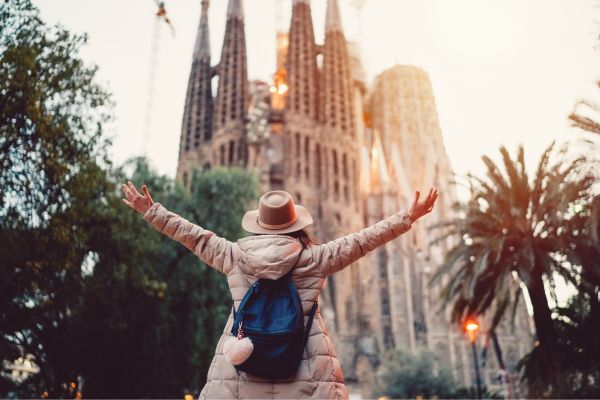
A pungent smell lingered in the thin air, the type you could taste. She complained as she walked the stone-lined streets of Lhasa, Tibet. She pinched her nose and let her eyes fall to the ground, listening to the methodical sound of her steps on the cobblestones. She didn’t look up. A victim of her own perspective, the girl moved through the dazzling city without ever truly experiencing it. She wasn’t traveling, she was simply passing through– her assumptions and discomfort preventing her learning and connection with her surroundings.
Too often, we approach travel as observers rather than participants. We take it for granted, missing out on the transformative opportunities. Travel is more than just time spent away from home; it is a deeply influential experience that can promote self-reflection and foster empathy, but only if we choose to jump in head-first and appreciate our differences while magnifying our similarities.
Through exposure and immersion in diverse cultures, travel offers us an unique opportunity to confront our preconceived notions and biases. As Jonathan Look, a travel writer for Forbes, says, “Demonizing strangers is easy. It is harder to demonize friends.” True travel is an attempt to reach out and embrace difference. By humanizing the experiences of strangers, travel encourages us to see our similarities– “We learn that people of all cultures basically share the same aspirations and hopes that we have.” When we travel with intention, when we travel with a desire to learn and grow, we gain a deeper understanding of each other and the commonality of the human experience.
That being said, travel does not inherently make us better people.
Rather, travel is a tool. It is up to us to step outside of our comfort zone and embrace the unfamiliar. Travel has the potential to be transformative, but it requires intentionality and curiosity.
In our increasingly digital world, this emphasis on experience and engagement is often replaced by surface-level or performative tourism, where the main focus is finding the perfect photo. According to a recent study, 40.1% of travelers, 18 to 33 years old, choose their vacation destination according to how “Instagrammable” it is. And while social media has significantly increased the popularity of travel, with over 75% of tourists using it as inspiration, many argue it removes the authenticity of the experience. Chris Bukrard, a famous travel photographer, says, “Share your own experiences instead of trying to mimic others.” He advises all tourists to travel with intention and authenticity, suggesting that the most meaningful experiences come not from photographs but from genuine moments of connection and personal growth.
But why is all of this important? Why does the way we travel matter?
If not for your own personal growth, then for our world. Travel bridges the distance between nations and people, and can help ensure a peaceful future for all. In 2024, global inbound tourist arrivals exceeded 1.4 billion. Travel has a profound impact on our world, so we must do everything in our power to ensure that its influence is positive.
I have changed so much since I was that girl in Lhasa, with her eyes glued to the floor. Travel has the power to be transformative, on both a personal and global scale. Immersing oneself in discomfort and the unfamiliar encourages substantial growth and reflection. It teaches us to learn from the very experiences that make us want to look away. Travel, when done with intention and humility, provides us with an opportunity to break down stereotypes and connect across communities. So let’s choose to step outside of our comfort zones. Let’s choose to immerse ourselves in foreign environments. Let’s choose to build connections across divisions, and let’s choose to look up.
Let’s choose to travel.

- United States of America